

Today, in this post, our cybersecurity team will discuss the most important topic, “social engineering”. Social engineering is the art of what three things: Manipulating, Influencing and deceiving is the main things of social engineering.
Keep reading to learn more about social engineering and prevention methodology.
What is Social Engineering?
Social engineering is a type of manipulation that exploits human psychology, rather than technological hacking techniques, to gain unauthorized access to a computer.
In this attacking technique, the attackers use a human strategy to trick the target people into performing an immediate action. This is called “human hacking”; victims give access to a system, send money to attackers, and spread malware to gain sensitive information, or share login credentials.
Social Engineering Attack Techniques
There are a few social engineering attack tactics where human interaction is involved. The most common social engineering attack methods are as follows:
- Phishing attack
- Spear Phishing
- CEO Fraud
- Vishing
- Pretexting
- Baiting
- Tailgating
1. Phishing Attack
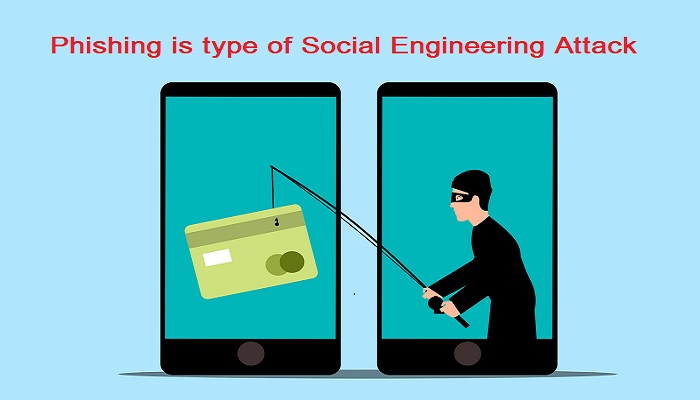
Phishing is the most common social engineering attack, where attackers gain unauthorized access to sensitive and confidential information such as usernames, passwords, credit card information, and network credentials. The most common forms of phishing techniques are as follows:
Phishing Technique 1: In this technique, the attackers send an email message to victims that seems to be a trusted message, and ask victims to send their personal information.
Phishing Technique 2: In this technique, attackers send an email message to victims with a URL link. The URL is almost a legitimate link, but when hovering over the link, it redirects to a vulnerable website.
The redirection site has a serious vulnerability or malware script to gather personal information that is unknown to the victims.
Learn more about Phishing attacks.
2. Spear Phishing
Spear phishing is another social engineering attack that attempts to gain unauthorized access and steal sensitive information from a specific victim. In this technique, the attacker sends an email or message to the victim with the victim’s data, such as name, designation, email, contact number, and address.
The reason for including this personal information is to gain the victim’s confidence and, therefore, compromise and access the confidential information they (the attacker) are looking for.
3. CEO Fraud
CEO Fraud is a type of email-based phishing attack in which the attacker acts as your senior company executive to gain access to sensitive data or steal funds or login credentials. In this attacking technique, the attacker sends an email and uses the name of your company’s CEO, but uses another email address.
The attacker’s domain email address is very similar to your company’s email domain, except few different letters, such as hafsteh.com instead of hafsateh.com. The main target of CEO fraud phishing (attackers) is the company’s finance department.
4. Vishing Attack
Vishing is a social engineering attack that is a combination of ‘voice’ and ‘phishing’. Already, our cybersecurity expert has defined phishing attacks. Now, a vishing attack is the illegitimate access of data via VoIP (Voice over Internet Protocol).
It can be conducted by regular phone calls or voice email and requesting to send the victim’s bank account details, and also requesting to pay some money. It is very difficult to trace the vishing attack because it occurs within a very short time.
One of the most common techniques of vishing attack is as follows: For example, you will get a phone call with the following message:
“Your account has been compromised. Please call this number to reset your password”.
The vishing perpetrator (Visher) hopes that you will fear after hearing the above message. In that case, when you call the number, the visher will leave, and you will hear an automated recording informing you that your bank account has been compromised and asking for information such as bank account numbers and other sensitive information.
5. Pretexting
Pretexting is another social engineering technique where attackers focus on creating an excellent pretext or a fabricated situation to gain sensitive information from victims. Typically, faith or trust is one of the most significant aspects of social engineering. So, a strong pretext is an important element in creating trust.
That’s why, to build trust in victims, pretexters (criminals) can impersonate survey firms, police officers, bankers, tax authorities, insurance companies, and audit firms.
Pretexters use different types of strategies to steal victims’ personal information. For example, a pretexter may call the victim a police officer and ask the victim some questions. In these attacks, the pretexter usually says they need some personal information to verify their (victim’s) identity.
The personal information can be Social Security numbers (SSN), usernames, passwords, or other sensitive information. If victims provide his/her information, then the pretexter will take action for secondary attacks.
6. Baiting Attack
Baiting is another type of social engineering that uses a fake promise of a product to attract a victim’s interest. They (attackers) bait users into a trap and then steal the victim’s sensitive information or damage their systems with malware.
In that case, the baiter (cyber-criminal) will give up the malware-infected flash drive in an eye-catching area where victims can easily find it, such as bathrooms, elevators, reception desk, and parking place at a targeted company. When curious users plug it into their system and open the flash drive, they compromise their system with the attacker.
7. Tailgating
In a tailgating attack, an attacker seeks entry to a confined area where access is controlled by electronic access control (e.g., RFID Card), and the attacker lacks proper authentication. The main focus of this type of social engineering attack is to gain unauthorized physical access to the restricted area.
The attacker can simply walk in behind an authorized person who has access to that area. In that case, an attacker impersonates a deliveryman to deliver the parcels and waits until a legitimate employee opens their door. When the employee opens the door, the attacker asks the employee to hold the door open to enter the company.
Social Engineering is the Art of What Three Things?
Social engineering attackers exploit people’s weaknesses, including their faith, and influence individuals to visit a vulnerable website or click a malicious link. Now, social engineering is the art of what three things? So, the things are as follows:
- Manipulating
- Influencing and
- Deceiving

Manipulating
In the context of information security, social engineering is the art of psychological manipulation. Psychological manipulation is a type of social influence or skillful control by an attacker that aims to change the behavior of victims.
It uses various tactics such as psychological abuse, brainwashing, and emotional blackmail so they (victims) give up their sensitive information. It is also known as emotional manipulation.
Influencing
Influencing is another important social engineering art of things that affect others (victims). Social engineering influences the victims using various tactics and then gains the victim’s trust and gets unauthorized access to sensitive information and resources.
Deceiving
Social engineering is the art of what three things? The last essential social engineering art of things is deceiving, where the attacker sends an authentic message to the victims. The message seems to be from one of your trusted service providers or from your office, asking you to send personal information.
The message prompts victims to provide their personal information, such as usernames, passwords, credit card information, and network credentials. The attacker also provides a link that redirects victims to a malicious website to capture their sensitive information and login credentials.
Prevention of Social Engineering Attacks
Already, we have discussed what is social engineering, social engineering is the art of what 3 things, and its attacking techniques. Now, we will focus on how to prevent social engineering attacks. Here are some useful tips on how to prevent social engineering attacks:
Never Provide Personal Information
Don’t share your personal or organization-sensitive information, such as login credentials, network information, or credit card details, over the internet to protect from social engineering. If you want to secure your personal information from phishing and malware attacks, then you should apply the following useful tips:
- First, check whether the website is trusted or not.
- Don’t provide your information on an unknown site.
- Don’t share your login credentials with others.
- Use strong and unique passwords.
- Don’t use the same password for multiple accounts.
Delete Suspicious Email
A suspicious e-mail may contain a virus or malware to redirects you to a phishing website to hack your sensitive information.
- To avoid phishing emails, just delete those that raise confusion.
- Don’t click on suspicious emails.
- If the email is suspicious, then you can make a phone call to the sender to confirm as he sends the email.
- Or, simply delete the email, and you can also mark it as spam.
Use Antivirus Software
Antivirus software is a program that helps to protect your computer from virus and malware threats.
- To protect from viruses and malware, you should use professional anti-virus software such as Norton, Bitdefender, Kaspersky, Panda, ESET, Avast, or AVG.
- Keep up to date with the latest version.
Never Download Software From Unreliable Sites
It is strongly recommended that you download software and apps from trusted sources to prevent social engineering attacks. So, don’t download the software or apps from unknown sites because these sites may contain viruses or malware that will infect your computer.
A trusted website is secured by an SSL (Secure Socket Layer) certificate. In URL, it will start with https:// such as: https://hafsatech.com.
Don’t Browse Untrusted Websites
Don’t visit untrusted websites because they untrusted websites may contain viruses and malware. So, to protect from social engineering attacks, you should avoid browsing untrusted websites.
A trusted website is secured by an SSL (Secure Socket Layer) certificate. In URL, it will start with https:// such as https://hafsatech.com.
Enter Personal Information Only On Secure Website
If you need to provide your sensitive or financial information on a site, you have to make sure that the site is secure with an SSL (Secure Socket Layer) certificate. In URL, it will start with https:// such as: https://www.google.com.
Up-to-date Operating System
The operating system of your computer has important security functions that can help to protect it from social engineering attempts.
Steps on how to update the operating system:
- Start button > click Control Panel> System and Security> and click Windows Update.
- Click Check for updates. If updates are found, then click Updates.
Check The Correctness Of Email Addresses
Social engineering scammers typically send phishing emails, which look like valid or official emails. However, if you scrutinize closely, then you’ll miss something such as:
- An email will end in “.com” or others as it should, but the address may end differently.
- For example, you will get a phishing email from “work” instead of “business.com”
- The attacker has included “com” in the domain name to fool you.
So, you should check or examine the email address very carefully.
Conclusion
Social engineering is an attack that manipulates people into breaking normal security and gaining access to systems, networks, or physical systems. We have discussed that Social engineering is the art of what three things, attacking techniques and helpful prevention tips. Hope this article will be helpful for you to protect from Social engineering attacks.